
Your return on ad spend is 4.2. Your margin has not moved in twelve months. The agency's monthly report arrives full of green arrows and a ROAS graph that curves pleasingly upward. One of these things is not like the others.
Return on ad spend, or ROAS, tells you how much revenue you generated per pound of ad spend. It does not tell you whether you made any money. An agency can show you a 5x ROAS on a product you lose money on per unit, and both numbers can be true simultaneously. Most ecommerce PPC agencies have built their reporting, their pitch decks, and their incentive structures entirely around ROAS, because it is easy to present and usually points in a flattering direction. The actual P&L is someone else's problem.
This is a buyer's guide, not a pitch. By the end of it you will have a checklist you can use on us or on any other agency you are evaluating. The metrics to demand, the budget structures to understand, and the red flags that are easy to miss when you are sitting across from a very polished presentation.
What an ecommerce PPC agency is actually supposed to do
An ecommerce PPC agency plans, runs, and continually improves paid acquisition campaigns across channels including Google Search, Google Shopping, Performance Max, Meta Ads, and occasionally Microsoft or TikTok, for online stores. The goal is profitable customer acquisition at a cost that makes sense relative to the margin of what you sell. Not traffic. Not clicks.
That sounds obvious. In practice it is rarer than you would think.
The work divides into three distinct functions. Media buying is the strategic layer: which platforms, which campaign types, how budget is allocated across them. Account management is the ongoing operational work, bidding strategies, audience segmentation, product feed health, Google Merchant Center troubleshooting, attribution window decisions, and testing. Creative is the ads themselves: product imagery, copy variants, video assets. Some agencies handle all three in-house; many handle the first two and expect the client to supply creative. Worth establishing which before you sign anything.
Ecommerce PPC is also structurally different from B2B paid search, and the two disciplines do not translate as cleanly as agencies sometimes imply. When you run Google Ads for a software company, a conversion is usually a form fill or a demo request. When you run Google Shopping for a WooCommerce or Shopify store, you are managing live product feeds, dynamic remarketing audiences, attribution windows that have to account for abandoned baskets and return rates, and margin differences between product lines that can vary by 40 percentage points or more within the same catalogue. ONS Retail Sales data consistently shows online sales representing around a quarter of all UK retail spend, which means the stakes are real and the competition for each click is significant. An agency that is excellent at generating B2B leads and an agency that is excellent at ecommerce paid search are often different businesses with different skills and different instincts.
Your search visibility and traffic picture is bigger than paid alone, but on the paid side you want someone who speaks Merchant Center, not just Google Ads Editor.
The metrics that separate a profit-led agency from a click-led one
ROAS is a useful efficiency ratio. It is not a profit number. An agency that reports exclusively on ROAS is telling you how efficiently they spent your budget, not whether that spending made you better off. These are genuinely different things, and conflating them is the oldest trick in ecommerce paid media.
Consider a hypothetical store doing £200,000 a month in revenue with a blended ROAS of 4.0 and a gross margin of 30% on the goods they sell. Revenue minus cost of goods sold, or COGS, leaves £60,000. Subtract £50,000 in ad spend (the £200k at a 4x return) and the contribution margin from advertising is £10,000. Before any staff costs, fulfilment, software, or the returns that did not convert into exchanges. The ROAS looks healthy. The actual return on investment does not.
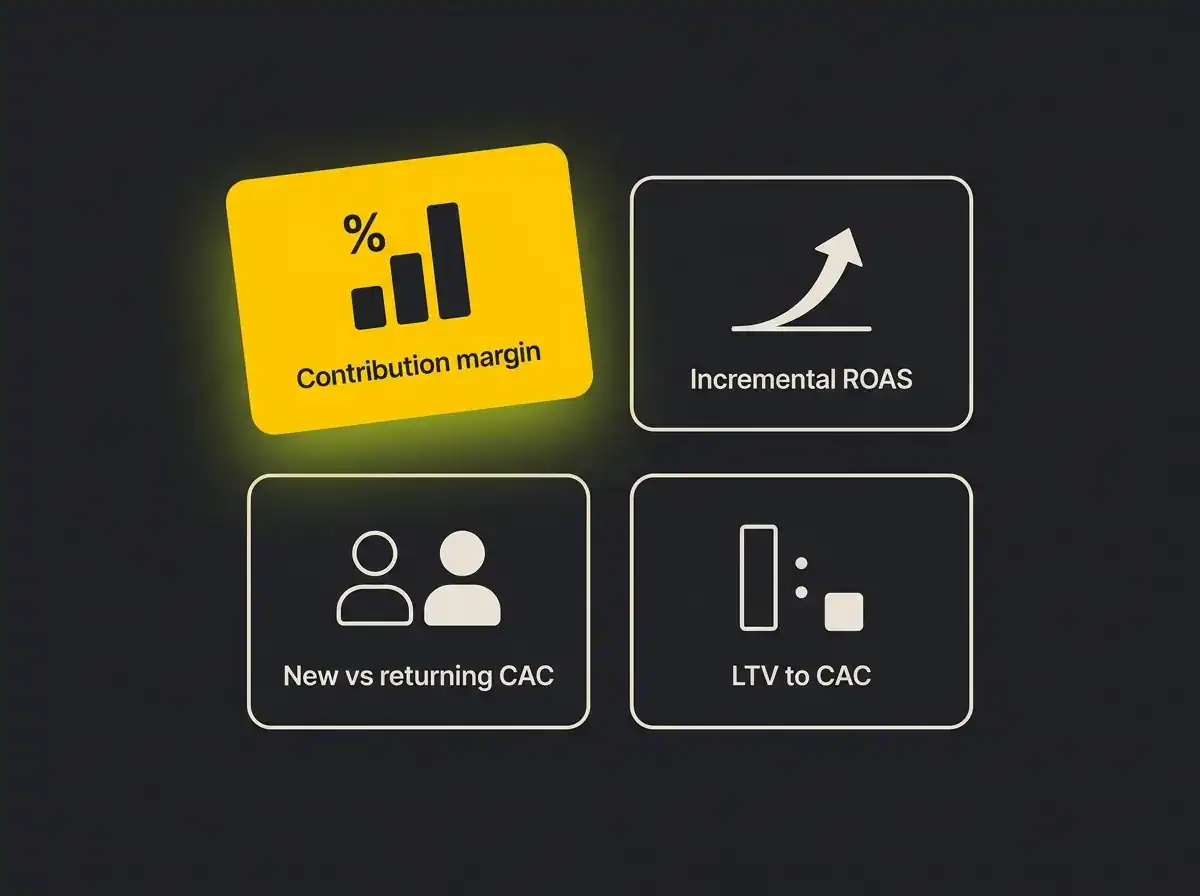
Here are the four numbers a proper ecommerce PPC agency should report on every month.
Contribution margin after ad spend. This is revenue minus COGS minus ad spend, expressed as a margin percentage. It is the closest approximation to "did the ads actually make us money" that you can calculate from campaign data without a full management accounts pack. Agencies that never ask for your COGS cannot produce this number. That gap, or that reluctance to ask, is itself worth noting.
Incremental ROAS, not blended. Blended ROAS includes customers who would have bought anyway: people who came through branded search, direct navigation, email, or word of mouth and happened to click an ad on the way. Incremental ROAS asks the harder question, specifically what revenue would we have lost if we had not run these campaigns at all. Incrementality testing is how you get close to that answer. It is methodologically more demanding than reading the Google Ads dashboard, which is precisely why most agencies do not raise it unless pushed.
New customer acquisition cost versus returning customer cost, reported separately. An agency running heavy remarketing campaigns can produce impressive ROAS by converting customers who were going to buy again regardless. That is not growth. Separating new customer CAC from returning customer CAC tells you whether you are building the business or harvesting what already exists. On a Shopify or WooCommerce store with GA4 properly configured, this split is achievable within the first 60 days of an engagement. If the agency has not produced it by month two, ask directly why not.
LTV-to-CAC ratio, or at minimum the 90-day repeat rate. Lifetime value, or LTV, divided by customer acquisition cost tells you whether the margin from repeat purchases justifies what you spent to acquire the customer in the first place. A store with a 40% 90-day repeat rate at a CAC of £35 looks completely different from a store with a 5% repeat rate at the same CAC. A good agency understands this and brings it into the conversation. An agency focused purely on first-purchase ROAS, without ever mentioning repeat behaviour, is chasing a number that can look strong while the underlying customer economics quietly deteriorate.
None of these metrics are exotic. They are the basics of ecommerce P&L applied to paid media. If the agency you are evaluating goes quiet when you raise them, you have learned something important.
How agency pricing actually works (and what each model incentivises)
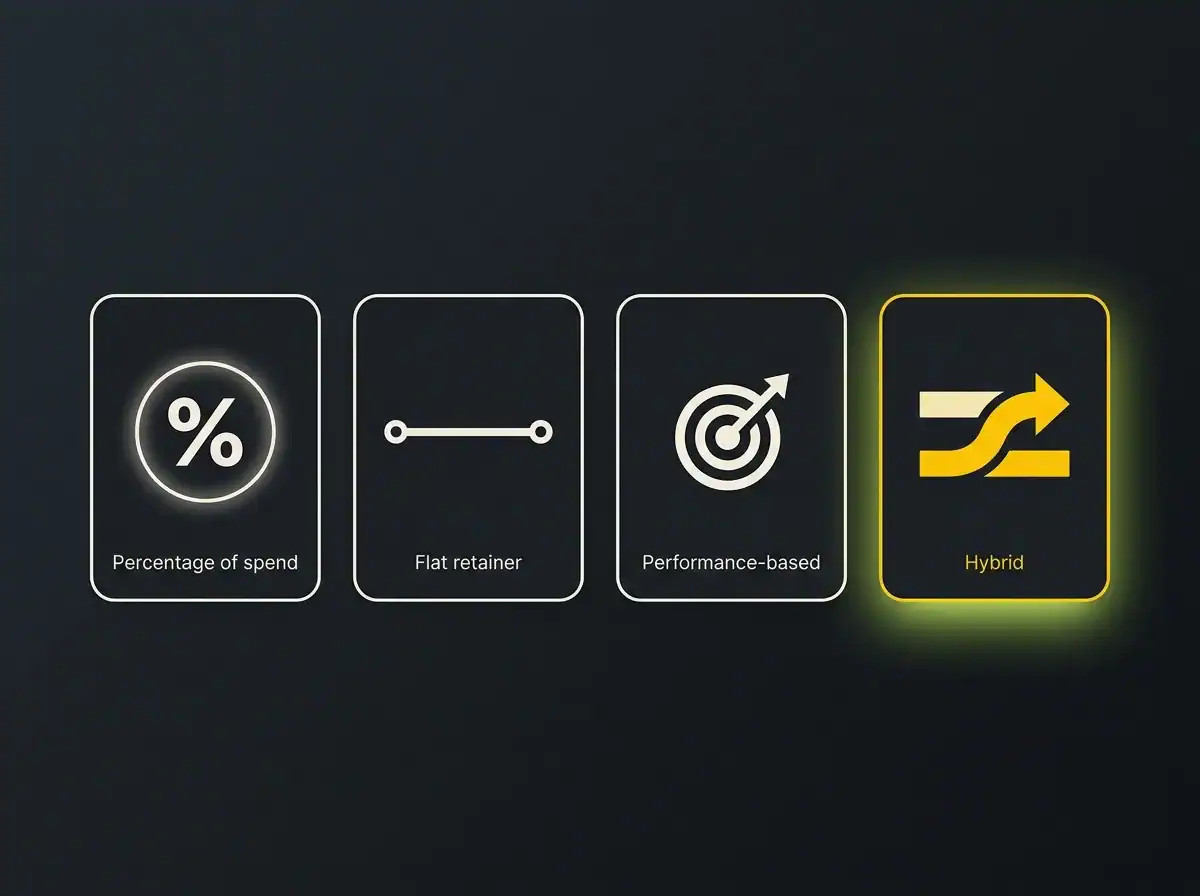
There are four standard pricing structures in UK ecommerce PPC. Understanding what each one incentivises is at least as important as understanding what it costs.
Percentage of ad spend. The most common model. The agency charges between 10% and 20% of whatever you spend on ads each month, usually with a monthly minimum. At £10,000 of ad spend, that means £1,000 to £2,000 in management fees. The structural problem is built into the maths: a percentage-of-spend agency earns more money when your budget goes up, regardless of whether the additional spend produces proportionate results. They are not all cynical about this, but the incentive is misaligned. Worth knowing when they recommend increasing budget.
Flat retainer. A fixed monthly fee regardless of ad spend, typically ranging from around £1,500 to £8,000 per month depending on account complexity, the number of platforms, and the scope of any creative work included. The incentive alignment is better: the agency's revenue does not scale with your budget, so recommendations should be more neutral. The risk is the opposite one. A flat-fee agency that takes on too many clients can underservice yours, because there is no financial upside to spending more time on an account than the retainer covers. Ask how many clients each account manager runs.
Performance-based. The agency takes a share of revenue they generate. Sounds ideal; works badly in practice. The reason is attribution. Performance Max campaigns, cross-channel journeys, and the reality of GA4 data make it genuinely difficult to agree on what revenue the agency actually caused versus what would have happened anyway. Most reputable agencies will not work on pure performance terms for this reason. If an agency pitches you a purely performance-based model with no retainer at all, that warrants closer scrutiny rather than enthusiasm.
Hybrid. A base retainer plus a performance bonus above an agreed result threshold. This is the model with the most sensible structural alignment: the base fee covers the agency's real costs and time, the performance element gives them a reason to push for results above the baseline you agree together. It is increasingly common among the better-run agencies, and worth asking about even if they do not offer it by default.
No model is categorically right or wrong. What matters is understanding what the model rewards the agency for doing, and then watching whether they behave consistently with your interests.
What good looks like in the first 90 days
A good ecommerce PPC agency does not promise dramatic results in month one. They do diagnostics. This is the distinction that separates agencies that are genuinely competent from agencies that are genuinely good at pitching.
In days 1 to 30 you should expect a full account audit: existing campaign structure, keyword coverage, product feed quality, Merchant Center health, and a conversion tracking sanity check. That last element matters more than it sounds. A GA4 implementation that is not tracking purchases correctly, a Shopify store where standard conversion events are firing twice, or a Performance Max campaign where "website visits" is being counted as a conversion will produce data that is confidently and completely wrong. A good agency catches this in the first 30 days and fixes it before launching anything new.
Days 31 to 60 are the rebuild phase. New campaign architecture that reflects the margin differences across your product catalogue, early creative tests running, attribution model agreed in writing, and baseline reporting established so there is a clear before-and-after when the results conversation starts. You should be able to see what they are testing and why. Not just a campaign name in a dashboard, but a hypothesis and a success metric behind it.
Days 61 to 90 should deliver the first real profitability read-out. Not "your ROAS improved", but a view of contribution margin against the baseline from the audit. Learnings from the creative tests fed into the next quarter's plan, and a clear picture of where the account is heading.
None of this is exciting. It is methodical in exactly the way that building something properly is methodical. An agency that promises dramatically improved performance within the first month has almost certainly skipped the diagnostic work that makes durable improvement possible.
What bad looks like (red flags from pitch through to month three)
During the pitch:
-
They lead with a "Google Premier Partner" badge as the primary trust signal. The badge has some meaning for platform access and support; it tells you nothing about whether they can manage your margin.
-
They cannot explain what COGS means, or they have never asked a client for it. If they do not understand your cost structure, they cannot report on your profitability.
-
They do not ask about your return and refund rates. For most ecommerce categories, returns represent 10 to 30% of gross revenue. An agency that has never thought about this is not thinking about the full picture.
-
They promise a specific ROAS target before reviewing the account.
-
They describe "traffic" as the primary goal.
Month one:
-
No audit, or a generic audit document that could apply to any ecommerce account without reflecting the specifics of your catalogue and margin structure.
-
No questions about your conversion tracking setup. No verification that what is being counted as a conversion is actually a completed purchase.
-
Dashboards that report cost-per-conversion without anyone having confirmed whether the conversion event fires correctly. This is one of the most common problems in ecommerce paid media, and it is painful to discover six months in.
Month two:
-
ROAS-only reporting with no new-customer versus returning-customer split.
-
No mention of incrementality, even in passing.
-
Ad spend increasing without a clear articulated reason for why additional budget should produce proportionate additional returns.
Month three:
-
"Give it more time" as the primary response to flat results, without a diagnosis of what is causing them.
-
No creative refresh. Ad fatigue is real across both Google and Meta; an agency still running the same assets from month one without testing alternatives has effectively stopped working on the account.
-
No commentary on landing page or product page performance. If specific products are getting clicks but low conversion rates, the problem might be the page, the price, the images, or the delivery information. Diagnosing that and pointing it out is part of the job.
On the landing page question specifically: if an agency tells you the website is the problem, they might be right. But "the website is the problem" without identifying which pages, which user flows, and what specifically causes the drop-off is not a diagnosis. It is a redirect. A good agency can tell you exactly where the landing page is doing the conversion work and where it is not, and give you something concrete to act on rather than a vague recommendation to "improve the site experience."
The questions to ask before you sign anything
These work in any pitch meeting, with any agency, including ours.
What is your reporting cadence and what is actually on the report? The answer tells you immediately what they measure and value. If the monthly report does not include contribution margin or new-versus-returning customer split, ask whether it can.
How do you measure incrementality? Not every agency uses formal holdout testing, and for smaller accounts it may not be practical at every point. But any senior paid media person should have a considered view on how to approach the question of whether spend is truly causal. A blank look at the word "incrementality" is a useful data point.
How will you separate new customer and returning customer performance? If they have not thought about this, they have not thought about your growth trajectory.
What does the first 90 days look like? The answer should include an audit phase, a tracking verification step, and a rebuild before any performance claims. If they jump straight to "we'll launch improved campaigns in week one," press them on what the audit process involves.
What is your average tenure with ecommerce clients? Agencies that do good work retain clients. Average tenure of two years or more is a positive signal. A portfolio of clients on rolling three-month engagements is a less positive one.
Who actually runs my account day to day? The senior person in the pitch is rarely the same person managing the account on a Tuesday morning. Ask to meet the account manager before you sign. Not after.
What is your offboarding process if we decide to leave? A reputable agency gives you full admin access to your ad accounts, your creative assets, and your historical data from day one, with no friction on departure. Agencies that make handover complicated are protecting their retention through inconvenience rather than results.
What ecommerce platforms do you have product feed experience with? Shopify, WooCommerce, BigCommerce, Magento, and custom builds all require different approaches to feed management in Google Merchant Center. If your platform is unfamiliar to them, ask how they have handled that gap with other clients.
Can I speak to two clients in a similar margin band? Not just the most impressive case study they have. A reference from a high-margin subscription brand tells you little about their work with a mid-margin homeware store. Ask for references from the category closest to yours.
When an ecommerce PPC agency is the wrong move
Three situations where bringing in a PPC agency is the wrong next step.
Your monthly ad spend is under around £1,500. At that level, the agency's management fee takes up a disproportionate share of the available budget, and the account does not generate enough data volume for meaningful testing and iteration. A specialist freelancer or an in-house hire will usually serve you better until the spend justifies the overhead.
Your tracking is broken. No agency can save you from bad data. If you are not confident that your GA4 and Google Ads conversion tracking are correctly configured and firing on the right events, fix that before anything else. Campaigns running on broken tracking produce confident-looking reports of nothing real. For stores on WooCommerce in particular, the WooCommerce design tweaks that lift conversion rates often go hand in hand with the tracking improvements that make paid campaigns interpretable.
You have a pricing or product problem, not a traffic problem. PPC will not rescue a store that loses money per order before ad spend is factored in. If your COGS plus fulfilment plus average return cost exceeds your average order value, more traffic accelerates the loss. Pricing, product mix, or contribution margin structure is the fix, not bidding strategy.
For what sits alongside paid, or eventually replaces its more expensive components: organic search as a long-term acquisition channel takes longer to build but is not subject to the rising cost-per-click dynamics that erode paid margins as categories become more competitive. The stores with the most resilient customer acquisition costs tend to be the ones that treat paid and organic as complementary, not as alternatives.
A checklist you can take into any PPC agency conversation

Before committing to any ecommerce PPC agency, run through these.
-
Metrics: do they report on contribution margin after ad spend, incremental ROAS, and new customer versus returning customer CAC? If not, can they?
-
Pricing model: do you understand what the model incentivises? Have you asked whether a hybrid retainer-plus-performance structure is available?
-
First 90 days: does onboarding include an audit, tracking verification, and a rebuild phase before any performance claims?
-
Pitch red flags: did they ask about your COGS and return rates? Did they avoid guaranteeing a ROAS before reviewing the account?
-
Account ownership: do you have admin-level access to your Google Ads, Google Merchant Center, and Meta Ads accounts from day one?
-
References: have you spoken to a client in a similar category and margin band, not just the agency's most prominent name?
-
Account manager: have you met the person who will run the account day to day, before signing?
If you want to see what your store could realistically do across paid, organic, and AI search before committing to a new agency, our Traffic Projection Report shows the gap between where you are and what is achievable given your current market position. It is a useful starting point for any conversation about where to invest next.
Whether you end up working with us or just take this checklist into the next pitch you sit through, we have done our job here.